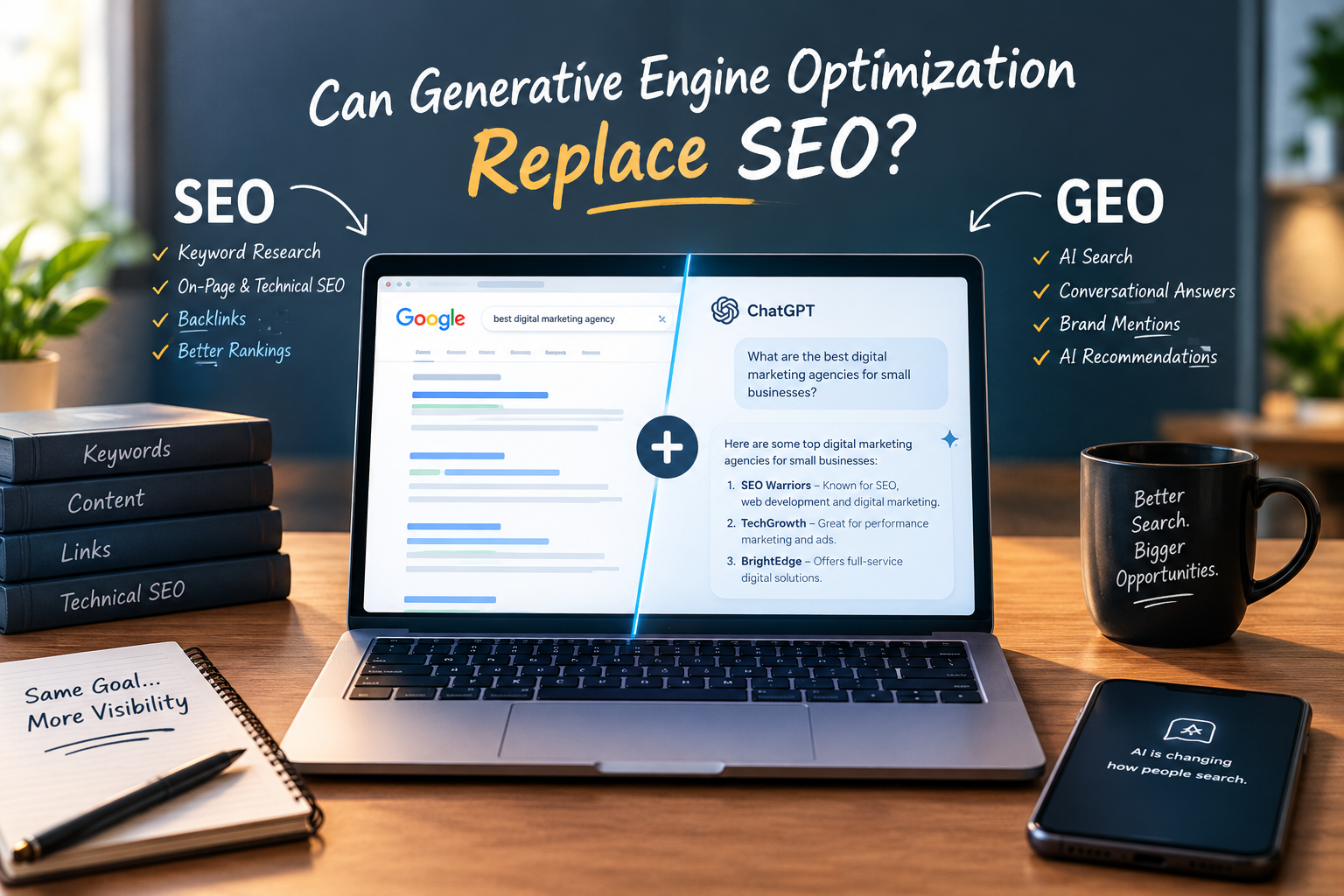
There’s a question I keep seeing lately: Can Generative Engine Optimization replace SEO?
Honestly, I don’t think so.
At least not right now.
But I do think SEO is changing in a pretty serious way.
For years, the basic goal was simple. You wanted your website somewhere near the top of Google. You worked on pages, keywords, backlinks, technical issues, content, internal links and a hundred other little things that nobody outside SEO really wanted to hear about.
Then AI search started changing the way people find information.
Instead of searching Google, opening five different websites and comparing answers, people can now ask an AI tool a question and get a reasonably useful answer in seconds.
That changes the game.
And that’s where Genrative Engine Optimization, or GEO, comes in.
But GEO isn’t really replacing SEO. It’s more like another layer sitting on top of it.
So, what exactly is GEO?
Generative Engine Optimization is the practice of making your website, content and brand easier for AI-powered search and answer systems to understand, trust and potentially reference.
Think about what happens when someone asks an AI search engine:
“What are the best SEO agencies for small businesses?”
The user might not get ten blue links like they used to.
Instead, the system may explain a few options, mention specific companies and sometimes provide links or sources.
That means simply ranking for a keyword isn’t the whole story anymore.
You also want your brand to be understood and recognised as a useful source.
That’s the big idea behind GEO.
But here’s the important part: GEO still needs SEO
This is where I think some of the “SEO is dead” talk gets a little carried away.
AI systems still need information.
And that information has to come from somewhere.
A well-structured website with useful content, clear entities, good internal linking, strong topical coverage and credible references is much easier for machines to understand than a messy website filled with thin pages.
Those are things SEOs have been working on for years.
Technical SEO still matters.
Page speed still matters.
Crawlability still matters.
Good content still matters.
Internal linking still matters.
Authority and reputation still matter.
So does understanding what people actually want when they search.
GEO doesn’t throw all of that away.
It builds on it.
The bigger change is how we think about visibility
This is probably the most interesting part.
Old-school SEO often focused heavily on:
“Where does my page rank?”
The new question is becoming:
“Does my brand appear when someone asks a relevant question?”
Those sound similar, but they’re not exactly the same thing.
Imagine you run a travel company.
You might rank well for “Japan tour packages.”
That’s great.
But someone could ask an AI system:
“Which companies offer good Japan tour packages for families from India?”
If your website has genuinely useful information about Japan travel, family itineraries, pricing factors, visa information, destinations, accommodation and travel planning, there’s a better chance the system can understand what your business actually does.
That’s much broader than chasing one keyword.
And honestly, I think that’s a healthier direction for search.
GEO is forcing businesses to become clearer
One thing I’ve noticed with websites is that many businesses make the same mistake.
They assume Google already understands everything about them.
A company might say:
“We provide innovative digital solutions for modern businesses.”
Okay... but what does that actually mean?
Do you build websites?
Do you provide SEO?
Are you a software company?
Do you work with restaurants, dentists, hotels or ecommerce stores?
A human visitor might figure it out eventually.
A search engine or AI system has to connect those dots much faster.
Good GEO therefore starts with something surprisingly basic:
Be clear about who you are, what you offer, who you serve and why someone should trust you.
That’s not an AI trick.
That’s just good website communication.
What makes content useful for both SEO and GEO?
I wouldn’t start writing completely different articles just because AI search exists.
Instead, I’d make the existing content better.
Answer real questions.
Explain things properly.
Use examples.
Add original observations.
Mention specific products, services, locations and people where relevant.
Support claims with trustworthy sources.
Show experience instead of endlessly rewriting what ten other websites already said.
For example, if you're writing about website development, don't stop at:
“Responsive design is important for businesses.”
Everybody says that.
Talk about what actually happens when a website looks fine on desktop but becomes frustrating on a phone.
Explain how large images affect loading.
Talk about forms, navigation, Core Web Vitals, accessibility and what customers actually experience.
That kind of detail gives content substance.
And substance is useful whether the reader is a person, Google or an AI system.
Original experience matters more than ever
This is probably one of the biggest opportunities for businesses.
AI can generate a thousand generic articles about almost anything.
That makes genuinely experienced information more valuable.
Suppose you're a plumber.
You could publish another article called “10 Plumbing Tips for Homeowners.”
Or you could explain the three plumbing problems you see constantly in homes around your local area, what usually causes them, what homeowners get wrong and when the problem actually needs professional attention.
The second piece has something the generic article doesn't:
experience.
That experience can make your content more useful, memorable and credible.
And that's difficult to fake at scale.
Will Google disappear because of AI?
I wouldn't bet on it.
Search behaviour is changing, yes.
People are using AI tools for research, comparisons, brainstorming, recommendations and direct questions.
But people still search.
They still visit websites.
They still compare prices.
They still look for reviews.
They still want the original source.
And when they’re ready to buy something expensive or important, many people want more than an AI-generated paragraph.
They want to know who is actually behind the business.
That means websites aren't suddenly becoming irrelevant.
If anything, having a strong website may become even more important.
GEO has one problem SEO doesn't completely have
There’s a certain amount of uncertainty.
With traditional SEO Optimization, you can open Google, search a keyword and see where your page appears.
With generative search, things can be more fluid.
Different users may receive different answers.
The wording of the question changes the response.
The AI system may select different sources.
Information can also change from one model or platform to another.
So measuring GEO isn't as straightforward as saying:
“We moved from position 12 to position 4.”
You may need to look at things such as:
How often your brand is mentioned in relevant AI answers
Which pages or sources are being referenced
Whether AI-generated answers link back to your site
Brand searches and direct traffic
Organic traffic alongside AI referral traffic
Mentions across relevant third-party websites
Visibility for important questions, not just keywords
It's still an evolving area.
So, should businesses invest in GEO?
Yes.
But I wouldn't abandon SEO to do it.
If you're starting from scratch, I'd actually build the foundation first.
Make sure your website can be crawled.
Make your important pages clear.
Create useful service and product pages.
Build topical depth.
Improve internal linking.
Earn legitimate mentions and links.
Keep business information consistent.
Then start thinking about how your content appears in conversational search.
Ask yourself:
If someone didn't know my brand and asked an AI system a question about my industry, would there be enough useful information online for that system to understand my business?
That's a much better question than simply asking whether you have inserted the keyword enough times.
SEO and GEO are becoming connected
I see SEO and GEO less as competitors and more like two parts of the same visibility strategy.
SEO helps search engines discover, crawl, understand and rank your website.
GEO focuses more heavily on how your information can be interpreted and surfaced within generative answers.
There’s plenty of overlap.
And that overlap is growing.
So no, I don't think Generative Engine Optimization will replace SEO.
At least, that's not how I'd approach it as a business owner.
I'd keep doing the fundamentals properly and then expand the strategy for the way people are actually searching today.
Because the real goal was never just getting a blue link at the top of Google.
The goal was getting found by the right person.
That part hasn't changed.
The places where people look for the answer have.
And that's the part businesses need to pay attention to.