If you run a small business, SEO can sometimes feel like a game where the biggest websites already took all the good spots.
You search for a keyword related to your business and see huge brands, established companies, directories, and websites that have been around for years. Then you look at your own website and think, “How am I supposed to compete with that?”
Honestly, you probably shouldn’t try to compete with them on every keyword.
This is where long-tail SEO can make a real difference.
Instead of trying to rank for broad searches like “digital marketing,” “plumber,” “coffee shop,” or “accountant,” a small business can target more specific searches that closely match what a customer actually wants.
And sometimes, those smaller searches bring the better leads.
What Are Long-Tail Keywords?
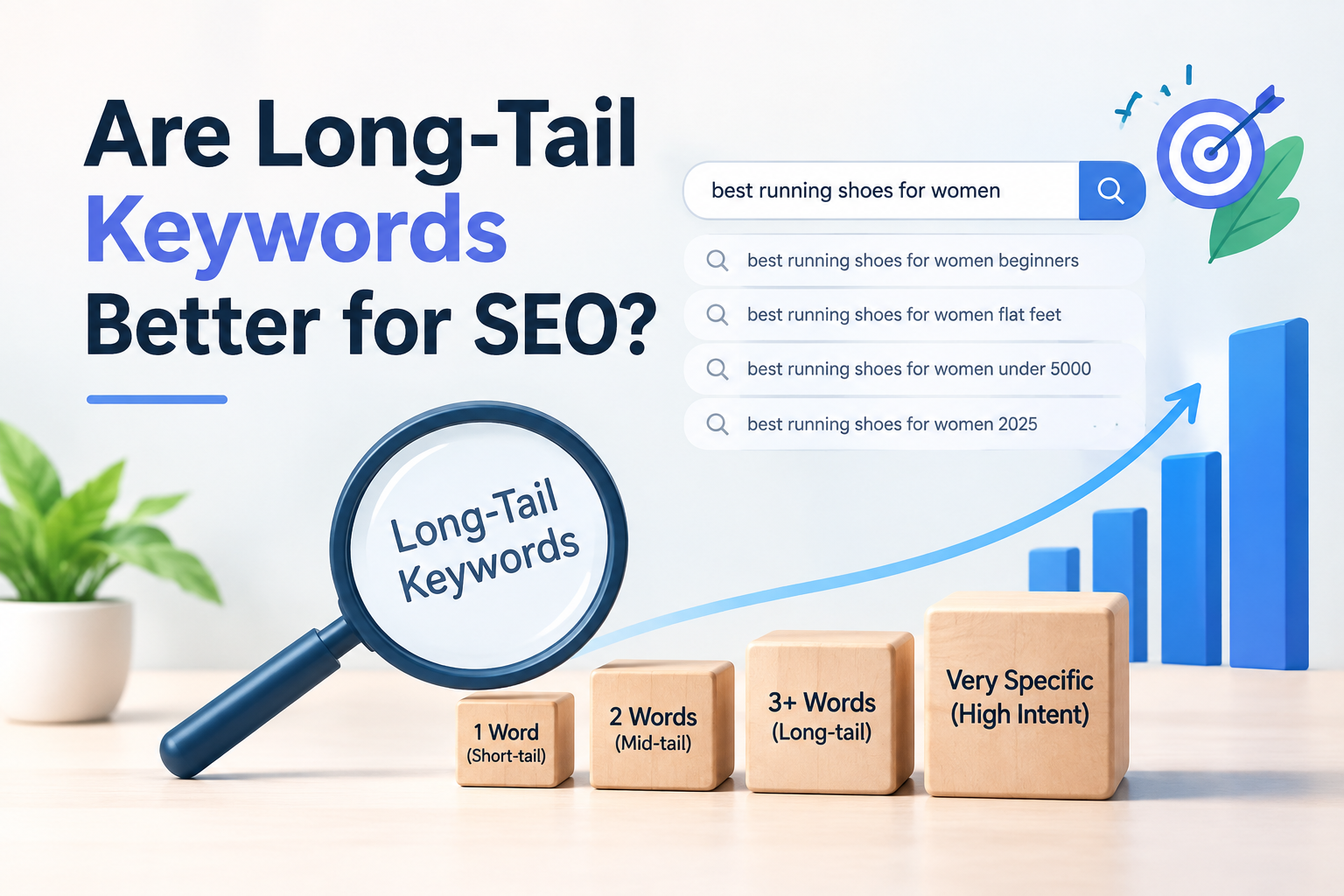
Long-tail keywords are usually more specific search phrases rather than broad, general terms.
For example:
“SEO agency” is broad.
“SEO agency for small businesses in Chicago” is more specific.
“local SEO services for dentists in Chicago” is even more specific.
The longer phrase may have fewer monthly searches, but that isn't necessarily a bad thing.
Someone searching for “SEO” could be researching what SEO means, looking for a job, comparing tools, or searching for an agency.
Someone searching for “SEO agency for small businesses in Chicago” has already told Google quite a bit about what they're looking for.
That's the interesting part of long-tail SEO.
You're not necessarily trying to attract more people.
You're trying to attract the right people.
Why Long-Tail SEO Works Well for Small Businesses
Small businesses usually don't have the same resources as large companies.
A big brand might have hundreds of pages, a large content team, thousands of backlinks, and years of domain history.
A startup might have a five-page website and one person doing everything from sales to customer support.
Trying to outrank those companies for extremely competitive keywords can take a lot of time and money.
Long-tail SEO gives smaller businesses another route.
You can find specific searches that are closely connected to your product, service, location, or customer problem and build useful pages around them.
For example, imagine a small company that provides air-conditioning repair.
Instead of only targeting “AC repair,” it could create useful pages around searches such as:
“emergency AC repair in Dallas”
or
“AC repair for older homes in Dallas”
or
“AC not cooling but running in Dallas”
These searches are narrower. But the person searching may have a very specific problem and may be much closer to contacting a business.
That's where the value can be.
Lower Competition Can Give Startups Room to Grow
One of the biggest advantages of long-tail SEO is that specific queries can be less competitive than broad keywords.
That doesn't mean every long-tail keyword is easy. Some are surprisingly competitive, especially commercial searches.
But smaller businesses can often find opportunities that larger competitors aren't focusing on.
Think of it like opening a small shop.
You don't necessarily need the busiest road in the entire city. You need the right customers to notice you.
The same idea applies to search.
A startup might begin by ranking for several highly specific queries. Over time, those pages can bring traffic, links, brand mentions, and customers.
As the website becomes more established, the business can gradually target broader topics.
Search Intent Matters More Than Keyword Length
Here's something that's easy to miss.
Long-tail SEO isn't simply about finding keywords with four, five, or six words.
The real opportunity is search intent.
Consider these two searches:
“best CRM”
and
“CRM for a small construction company with 10 employees.”
The second search gives you much more information about what the person needs.
A good SEO strategy looks beyond the number of words and asks:
What is this person actually trying to accomplish?
Are they looking for information?
Are they comparing products?
Are they ready to buy?
Are they trying to find a local service?
Are they trying to solve a specific problem?
That understanding should influence the page you create.
Local Businesses Can Get a Lot From Long-Tail SEO
For local businesses, long-tail searches can be especially useful.
A person searching for “hair salon” could be anywhere.
But someone searching for “women's hair salon near downtown Austin for balayage” is giving you a much clearer picture.
Location + service + customer need can create very specific opportunities.
This can work for:
plumbers
dentists
lawyers
restaurants
contractors
cleaning companies
mechanics
real estate businesses
marketing agencies
home-service companies
A local business doesn't need to rank for every possible search.
It needs to become visible when people in its service area are looking for the things it actually provides.
Long-Tail SEO Can Also Help With Content Planning
There's another benefit that doesn't get talked about enough.
Long-tail keywords can make content planning easier.
Instead of sitting in front of a blank document thinking, “What should I write about this month?”, you can look at the actual questions and problems people search for.
For example, a small accounting firm could create useful content around:
“How much does bookkeeping cost for a small business?”
“Do I need an accountant for my LLC?”
“Bookkeeping mistakes new business owners make”
“Tax preparation for small businesses in Texas”
These aren't just random blog topics.
They connect directly with problems potential customers may have.
And if the content is genuinely useful, it can become an entry point into the business.
Don't Create a Separate Page for Every Tiny Keyword
This is where some businesses go too far.
They find dozens of long-tail keywords and create a separate page for every slight variation.
That can quickly turn a small website into a pile of thin, repetitive pages.
You don't need that.
If several keywords have the same intent, one strong page may be enough.
For example, searches like:
“SEO services for small businesses”
“small business SEO services”
“SEO company for small business”
may all be addressed naturally on one well-written service page.
The goal isn't to create as many URLs as possible.
It's to create pages that genuinely deserve to appear in search results.
How a Small Business Can Start With Long-Tail SEO
You don't need a huge SEO campaign to begin.
Start with the services or products that actually make money for the business.
Then think about the questions customers ask before buying.
Look at:
Google Search Console data
customer questions
sales calls
support emails
competitor websites
Google's related searches
keyword research tools
local search queries
You might discover that customers are using completely different words from the ones you originally had in mind.
That's useful information.
Build pages around those real needs.
Then make sure the basics are handled: good page titles, useful content, sensible internal linking, fast mobile performance, clear calls to action, and accurate local information where relevant.
The Results May Start Small — And That's Okay
One of the hardest things about SEO for a startup is patience.
A new website may not suddenly receive thousands of visitors.
You might first get 20 visitors from organic search.
Then 50.
Then 100.
But perhaps one of those visitors becomes a $2,000 customer.
That changes how you should look at SEO.
Traffic is useful, but relevant traffic is what businesses can actually build on.
A small business with 500 highly relevant organic visitors can sometimes get more practical value from search than a website attracting thousands of people who aren't interested in buying anything.
So, Is Long-Tail SEO Worth It for Small Businesses?
Yes, long-tail SEO can be an effective strategy for small businesses and startups, particularly when the website focuses on specific customer problems, services, locations, and buying situations.
But it isn't a shortcut.
You still need useful content, a technically sound website, good internal linking, credibility, and time.
The difference is that you're choosing a more realistic starting point.
You don't have to walk into Google's busiest battlefield on day one.
Find the searches where your business genuinely has something useful to offer.
Answer them properly.
Build a few strong pages.
Watch what starts getting impressions and clicks.
Then build from there.
That's often how a small website starts becoming a serious search competitor — not by trying to rank for everything, but by becoming very useful for something specific.