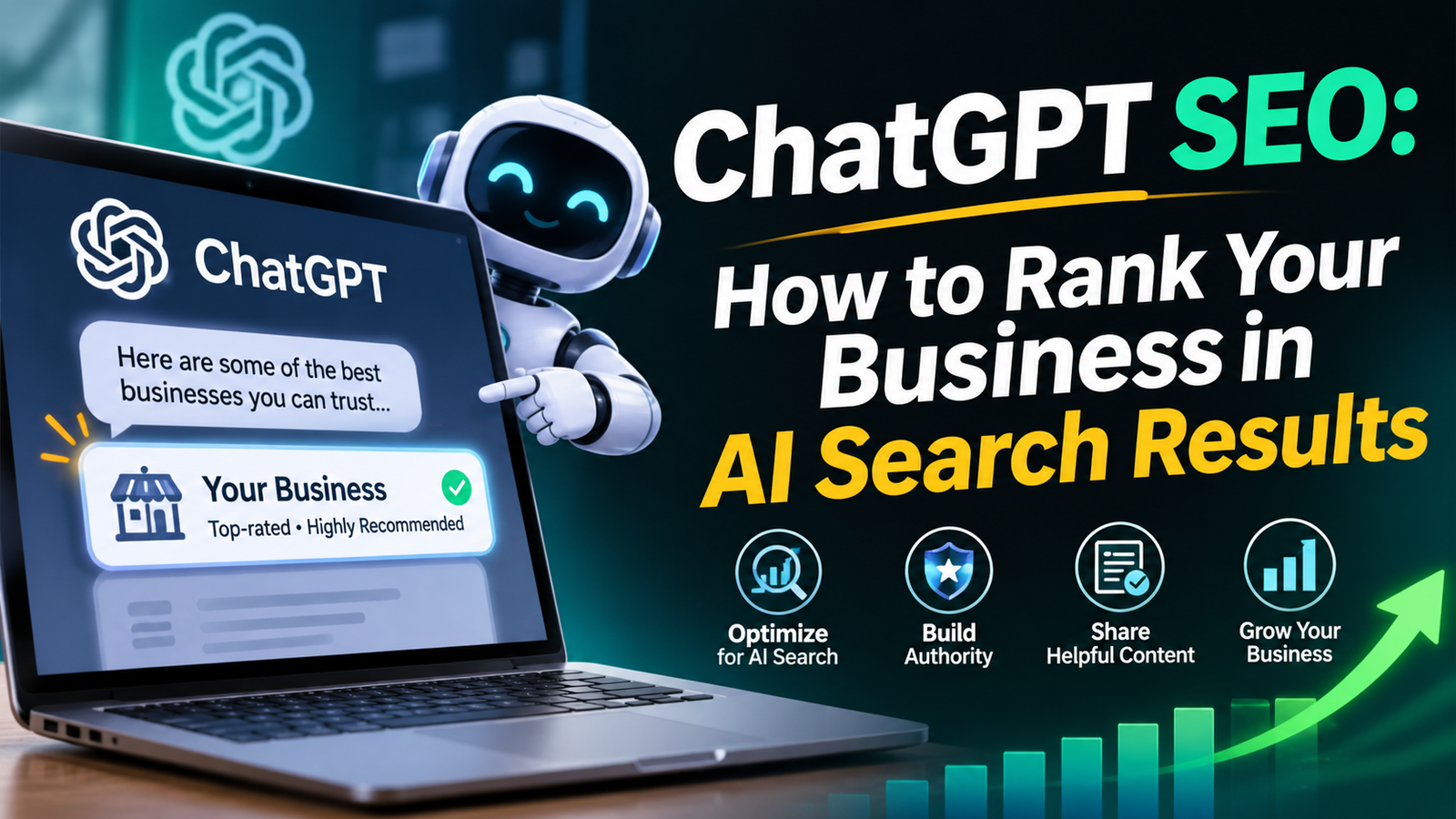
An AI assistant answering a commercial question is not querying an index in the way a search engine does. It is either drawing on training data, retrieving live web content, or both — and the balance between those two determines what you can influence.
Search behaviour is shifting from a list of links to a synthesised answer. A growing share of purchase and service inquiries now begin with a question posed to an AI assistant rather than a search engine, and the answer that comes back names a handful of businesses rather than returning ten blue links.
That changes what visibility means. Ranking first no longer guarantees being mentioned, and being mentioned is now the thing that produces the enquiry.
What follows is how AI assistants select the businesses they recommend, and what makes a business eligible to be one of them.
Understand what the model is actually doing
An AI assistant answering a commercial question is not querying an index in the way a search engine does. It is either drawing on training data, retrieving live web content, or both — and the balance between those two determines what you can influence.
Where retrieval is involved, the assistant is searching, reading a small number of sources, and synthesising an answer. Where training data dominates, the assistant is reproducing patterns absorbed during training, and the recency of that data varies by model.
The practical consequence is that how to get my business recommended by chatgpt is not one problem but two: being present in the sources the model retrieves, and being represented consistently enough across the web that the model's internal picture of your business is accurate.
Be citable, not merely ranked
Assistants cite sources. Being one of them requires content structured for extraction rather than for browsing.
That means direct answers stated plainly near the top of a page, rather than an answer distributed across six paragraphs of preamble. It means headings that match the questions people actually ask. It means factual specificity — prices, locations, service areas, turnaround times — expressed as statements rather than implications.
A page that ranks well because it is comprehensive and engaging may still be passed over in favour of a page that answers a specific question in two sentences. Extraction rewards clarity over comprehensiveness.
Fix the entity problem before optimising the content
An assistant recommending a business needs to be confident that the business is a real, specific, single entity. Ambiguity here is more damaging than thin content.
Ensure the business name, address, phone number and service description are identical across your website, your Google Business Profile, industry directories and social profiles. Inconsistent naming — a trading name here, a registered name there, a missing suite number — fragments the entity across the web and makes confident recommendation less likely.
Structured data helps. Organization, LocalBusiness and Service schema make the entity machine-readable rather than requiring inference. Review schema matters more than most businesses realise, because assistants frequently reference ratings when recommending.
Publish the content assistants quote
Three content types consistently surface in AI answers.
Comparison and alternatives content, because queries are frequently framed as "best X for Y" and assistants synthesise across lists rather than reproducing one.
Direct question-and-answer content, because it maps cleanly onto how queries are phrased.
Third-party mentions, because assistants weight independent sources more heavily than a business's own claims about itself. Being described accurately on review platforms, in industry publications and in local press is more influential than the same description on your homepage.
The last point is the one most businesses underinvest in. A business cannot easily assert its own authority to a model; it can only accumulate corroboration elsewhere.
Recognise that recommendations are locale-sensitive
AI assistants return different answers depending on where the user is, what language they are querying in, and which regional sources the retrieval layer draws from. A business that is prominent in one market is frequently invisible in another, not because the model is deficient but because the retrieved evidence differs.
This is why regional search expertise has not been displaced by AI search. A business targeting German-language queries needs German-language content, German directory presence and German-market citations; those are the sources a model retrieves for a user in Munich. Engaging a seo agency germany specialists understand is not a legacy tactic — it is addressing the retrieval layer that serves that market.
The same logic applies in Australia, where the directory landscape, review platforms and local press differ materially from the UK or US. A business competing for queries from Sydney or Melbourne is competing for retrieval against Australian sources. Working with an australian seo company that understands those citations is more effective than applying a US-derived playbook, and it is why seo in australia continues to command specialist attention rather than being absorbed into general AI-optimisation advice.
Measure mentions, not just rankings
Traditional rank tracking does not capture this. A business can rank third and be the only name in the assistant's answer, or rank first and be omitted entirely.
Track the queries that matter by running them through the assistants your customers actually use, from your target locations, and recording whether you appear and how you are described. Run it monthly. Note the sources cited alongside your name — those are the pages doing the work, and they indicate where further investment pays.
Also monitor for factual error. Assistants do describe businesses inaccurately, and the correction path is to fix the source rather than the model.
What does not work
Keyword density, thin service pages, and a blog of generic advice designed to capture search volume rather than answer questions. These were marginally effective in a link-based index and are largely inert in a retrieval-and-synthesis model.
Equally ineffective: attempts to manipulate what a model says about you directly. There is no submission form. Influence operates through the sources the model reads.
The sequence to follow
Establish entity consistency across every property you control. Add structured data. Rewrite key pages so the answer appears in the first two sentences. Publish comparison content and direct Q&A. Pursue third-party corroboration. Localise by market, because retrieval differs by region. And measure mentions monthly rather than rankings.
None of this replaces conventional search work. It sits on top of it, and it depends on it — an assistant can only cite a page that is crawlable, current and clear enough to extract from.